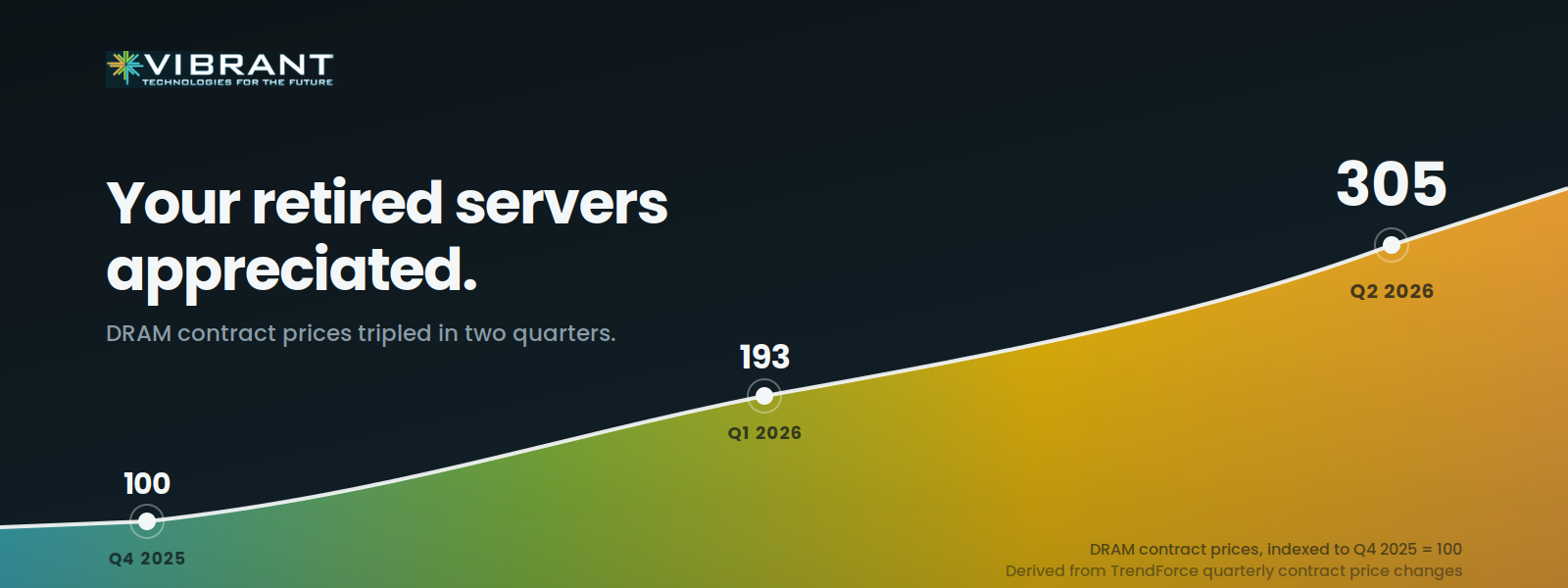
DRAM contract prices roughly tripled in two quarters. That changes what your decommissioned hardware is worth, when you should retire it, and where it should go next.
Every IT asset disposition program in the world is built on one assumption: hardware only goes down in value. Depreciation curves, refresh cycles, resale forecasts, the "we'll deal with that closet next quarter" instinct — all of it assumes that a server retired today is worth less than the same server retired six months ago.
For the first time in most people's careers, that assumption broke. Not for the whole box. But for the single most valuable thing inside it.
What Actually Happened
In January 2026, TrendForce forecast that conventional DRAM contract prices would rise 55 to 60 percent quarter-over-quarter in the first quarter, with server DRAM climbing more than 60 percent.
By February the firm had revised that forecast upward, to 90 to 95 percent. When the actual numbers came in, first-quarter conventional DRAM contract prices had risen roughly 93 to 98 percent QoQ. Second-quarter contract prices were then projected up another 58 to 63 percent.
Compound those two quarters and DRAM contract pricing roughly tripled between the end of 2025 and the middle of 2026. The market outran the people whose job it is to forecast the market, twice in six weeks.
The cause is not a logistics hiccup like 2020. It is a deliberate reallocation of fab capacity. DRAM manufacturers redirected advanced process nodes and new capacity toward server DRAM and high-bandwidth memory for AI accelerators, which constrained supply everywhere else. HBM consumes roughly three times the wafer capacity of standard DRAM, so every unit of AI memory produced costs the market several units of conventional memory.
Individual price points followed. Samsung raised its 32GB DDR5 module price from $149 to $239 in September 2025, a 60 percent increase in one move. SK Hynix told its October 2025 earnings call that its HBM, DRAM, and NAND capacity was sold out through 2026. Micron raised prices 20 to 30 percent and stopped quoting some products entirely.
The distortion ran deep enough to invert the normal order of things. Counterpoint Research noted DDR4 for budget devices trading around $2.10 per gigabit while server-grade DDR5 sold for roughly $1.50 — older, slower memory commanding a premium over newer memory, because the older production lines were being wound down.
Where the Market Sits Now
Prices have stopped accelerating. They have not come down.
TrendForce expects server DRAM contract prices to rise 13 to 18 percent quarter-over-quarter in the third quarter of 2026, a sharp deceleration from the first half. Several US cloud providers have signed multi-year long-term agreements that cap what suppliers can charge them, which pushes the remaining increases onto buyers without that leverage. Server CPU shortages have slowed system assembly, letting some inventory rebuild.
But the firm expects server DRAM contract prices to keep rising quarter by quarter from the second half of 2026 through the second half of 2027, just at a gentler pace. Moderation is not reversal. The step change already happened, and the new level is where the market now operates.
This is the part most asset disposition programs have not absorbed. The repricing is not a forecast to plan around. It is a fact to re-value against.
Three Things This Changes About Asset Disposition
1. The cost of sitting on retired hardware inverted — partially
The standard ITAD pitch has always been about speed: get the asset out of the closet before it depreciates. That advice is still mostly right. Chassis, CPUs, and drives continue to lose value on the usual curve, and every month a decommissioned rack sits in a storage room is a month of lost recovery.
But the DIMMs in those servers went through a step change in the opposite direction. If you decommissioned a fleet eighteen months ago and never processed it, the populated memory in those boxes is worth substantially more today than it was the day you pulled them.
The practical implication is not "wait longer." It's that the memory content of your retired fleet needs to be inventoried and valued separately from the chassis, because those two things moved in opposite directions and are now on different curves.
Most organizations don't do this. Most organizations don't know how much memory is sitting in their decommissioned equipment at all.
2. Component-level recovery beats whole-unit resale more often than it used to
A whole-unit sale is simpler. One buyer, one transaction, one line on the settlement report. Under normal market conditions it's frequently the right call.
After a tripling in memory pricing, the DIMMs in a mid-generation server can represent a large enough share of the unit's total secondary value to justify the extra handling of a component-level harvest — pulling and individually testing the RDIMMs, then routing them to a different channel than the chassis.
That's an operational question, not just a pricing one. It requires an ITAD partner who can test and grade memory at volume, has active channels for enterprise RDIMM specifically, and can report on it cleanly. Many can't. If your provider quotes you a single whole-unit number without breaking out configuration, ask what memory is in those units and what they're valuing it at.
3. Redeployment stopped being the sustainability answer and became the budget answer
Extending the life of existing hardware has always been the environmentally responsible choice. Now it is also the cheap one, which is a much easier conversation to have with a CFO.
A two-year-old server that needs more capacity does not need to be replaced. It needs modules. And the best source of those modules may be the systems you are retiring this quarter, harvested and redeployed rather than sold and repurchased at a market price you no longer control.
Before anything leaves the building, the question worth asking is whether the memory in it should stay.
The Honest Caveats
Secondary-market memory did not escape the run-up. It rose too. It simply started from a lower base, which is why it remains the value play rather than a free lunch — and why harvested inventory you already own is worth more to you than anything you can buy.
There is also a downgrade trap in new purchases worth flagging to procurement. When memory costs spike, configurations quietly shrink — the "same" system at the same price arrives with less RAM than last year's build. Compare specifications, not SKUs.
And none of this changes the security requirements. Memory is not a data-bearing component the way a drive is, but the systems it comes out of are, and a component-level teardown means more hands on more hardware. Chain of custody gets harder, not easier, when a single server becomes six separately routed part streams. Any component-level recovery program needs serialized tracking from the rack to the settlement report.
What to Do in the Next 90 Days
Inventory the memory you already own. Not the servers — the DIMMs. Capacity, generation, speed, rank, and which chassis they're sitting in, including anything already decommissioned and staged. Most organizations cannot produce this list today.
Reprice your staged assets. Any valuation of retired equipment done before 2026 predates a tripling in the memory market. It is not a little stale. It is describing a different market.
Ask your ITAD provider for a component-level quote alongside the whole-unit number. Compare them. If they can't produce one, that tells you something.
Check redeployment before you buy. Any capacity request that can be satisfied with memory from retiring systems should be, before a purchase order gets written.
Stop waiting for prices to normalize. TrendForce expects increases to continue through the second half of 2027, only more slowly. There is no version of the next eighteen months where deferring the decision gets cheaper.
The industry has spent two decades telling clients that retired IT is a liability to be safely disposed of. Right now, a meaningful part of it is an appreciating asset sitting unmanaged in a storage room. The organizations that treat it that way will recover materially more than the ones still working from a 2024 depreciation curve.
Vibrant Technologies has been buying, selling, and responsibly retiring enterprise IT hardware since 1998, and is R2v3 certified. If you have retired equipment awaiting disposition, we can tell you what it's worth in today's market — including a component-level breakdown of the memory in it. Request a valuation
Sources
- TrendForce, January 5, 2026 — Initial 1Q26 forecast: conventional DRAM contract prices up 55–60% QoQ, server DRAM up more than 60%. Press release
- TrendForce, February 2, 2026 — 1Q26 forecast revised upward to 90–95% QoQ. Press release
- TrendForce, March 31, 2026 — 2Q26 conventional DRAM contract prices projected up 58–63% QoQ. Press release
- TrendForce, June 1, 2026 — 1Q26 actuals: conventional DRAM contract prices rose approximately 93–98% QoQ. Press release
- TrendForce, July 9, 2026 — 3Q26 server DRAM contract prices expected up 13–18% QoQ; long-term agreements capping increases; rises continuing through 2H27 at a moderating pace. Press release
- Counterpoint Research, November 19, 2025 — DRAM crunch analysis, including the DDR4/DDR5 per-gigabit price inversion and the HBM wafer-consumption ratio. Insight
- Network World, November 20, 2025 — Reporting on Counterpoint's analysis, plus Samsung's 32GB DDR5 module increase, SK Hynix's October 2025 sold-out disclosure, and Micron's price actions. Article
Chart figures are indexed from TrendForce's published quarter-over-quarter contract price changes, using the conservative end of each range.